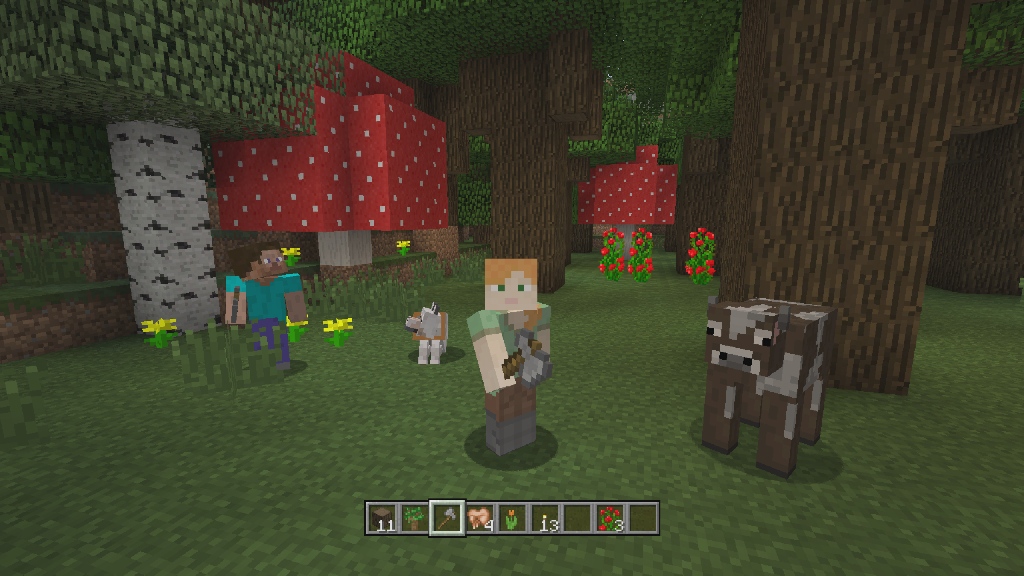
Minecraft is a world made of one-metre blocks that you can break, carry and place anywhere. Released by Markus Persson in 2009, finished by Mojang in 2011 and owned by Microsoft since 2014, it has no plot, no score and no way to win — you dig, build, explore and survive the night, and what you make stays. That open-endedness is why it became the best-selling game of all time, why it runs on everything from phones to consoles, and why teachers, city planners and hospitals use it for things that have nothing to do with gaming. This piece is a quick tour of the game itself: its editions, its creator tools and its serious uses, with links for depth. At the end there is a short note on Smart Island, the focus map we built on top of it.
The game, in one screen
- Origins. Markus "Notch" Persson published the first "Cave Game" build on 17 May 2009; Mojang formed in 2010; version 1.0 shipped on 18 Nov 2011 at MineCon, and Jens "Jeb" Bergensten took over as lead designer weeks later. Microsoft bought Mojang for US$2.5 billion in 2014. → Wikipedia · development history
- Scale. 350 million+ copies sold (April 2025), the best-selling game ever; analysts estimate around 210 million monthly players in 2026. A Minecraft Movie (2025) grossed US$961 million, the third-highest video-game film ever. → the film
- Two main editions. Java Edition (Windows/macOS/Linux) has open third-party modding and free self-hosted servers. Bedrock Edition (consoles, mobile, Windows; unified in the 2017 "Better Together" update) has cross-play, official Add-Ons and the paid Marketplace. They don't play together. → Java or Bedrock? · Bedrock on the wiki
- China Edition (网易《我的世界》). Licensed to NetEase in 2016, launched 2017; free-to-play, real-name ID required, its own launcher and an in-game component marketplace for maps, mods and skins. 800 million registered accounts as of 2025. This is the edition our map runs on. → China Edition on the wiki · mc.163.com
- Minecraft Education (2016) is a classroom build with coding, chemistry and lesson libraries built in. → education.minecraft.net
- Release cadence. Since 2024 Mojang ships several named "game drops" a year — Tricky Trials, Chase the Skies, The Copper Age, Mounts of Mayhem, Tiny Takeover, Chaos Cubed — and version numbers switched to year-based (26.1, 26.2…) in 2026. → game drops
Why this specific game works next to work
- No scoreboard, no losing. Nothing in a single-player world tells you that you are behind. You can walk away mid-session and the world just waits. Competitive games pull you back with a ranked queue; Minecraft does not pull at all. That makes it structurally low-arousal — the opposite of a feed.
- Persistent, visible progress. Twenty minutes of writing, five minutes of mining, and the tunnel is a little longer than it was. The reward accumulates into something you can look at. Points on a dashboard don't do that.
- It's programmable. Which brings us to the toolbox.
The creator toolbox, briefly
Minecraft's real product is the ladder from player to builder to programmer. Every rung has mature tooling:
- Redstone — the in-game circuit system. It is Turing-complete in the literal sense: the CHUNGUS 2 redstone CPU runs a playable Minecraft inside Minecraft. → Redstone · Minecraftception
- Command blocks & scoreboards — in-world scripting and state tracking; the backbone of every adventure map and minigame, including ours. → Command block · /scoreboard
- Data packs & resource packs — JSON-based gameplay and texture changes with no code. → Data pack
- Java mod loaders — Fabric, NeoForge, Forge; mods hosted on Modrinth and CurseForge.
- Servers & plugins — Paper (the de-facto standard), Spigot, Velocity proxy; plugins on Hangar. Mojang's hosted option is Realms.
- Bedrock Add-Ons & Marketplace — JSON + JavaScript behaviour packs; paid distribution through the Partner Program. → Creator docs
- Building tools — WorldEdit, Axiom, Litematica.
- Education coding — Code Builder (MakeCode blocks / JavaScript / Python), a Chemistry pack, and the free Hour of Code tutorials, which have logged 300 million+ sessions. → MakeCode · code.org/minecraft
- China Edition: MC Studio — NetEase's official developer suite (map, logic and effects editors, cloud testing, Python mod API). Creators submit "components" that, after review, are distributed through the in-game component centre. This is what Smart Island was built with. → MC Studio · developer docs
Where it already does serious work
- Classrooms. Minecraft Education is in 40,000+ school systems across 140 countries. The evidence is real but thinner than the marketing: a 2025 systematic review of 29 studies (Review of Education) found positive effects on spatial thinking, creativity, maths, science and language, while rating the quality of evidence as limited; a preregistered 6-week cluster RCT of 885 pupils (Learning and Instruction, 2024) found no overall spatial-thinking gain, only a gain in one age group. Motivation, however, rises consistently — and that is the part we borrow. → review · RCT
- Urban planning. UN-Habitat's Block by Block (with Mojang and Microsoft, since 2012) has run 150+ public-space projects in 55+ countries, letting residents redesign their own neighbourhoods block by block.
- Press freedom. Reporters Without Borders' Uncensored Library (2020) hosts censored journalism inside a 12.5-million-block building reachable from countries where the articles themselves are blocked; 25 million+ visitors.
- Therapy and hospitals. Autcraft, an autism-only server since 2013, has hosted 20,000 players and was the subject of an award-winning CHI ethnography; family-therapy techniques are now being adapted inside the game (Journal of Family Therapy, 2026); Seattle Children's runs a private server that recreates the hospital so bed-bound patients can play together.
- Geography and heritage. Denmark released its whole country at 1:1 from official elevation data (4 trillion blocks); Build the Earth is recreating the planet with 8,000+ builders; Tate and the Museum of London have turned collections and pre-1666 London into explorable maps.
- Workplaces. Microsoft trained staff on hybrid-work habits inside Minecraft, and Scrum.org runs sprint simulations in it. → workplace learning
- Study communities. Discord servers pair Pomodoro voice rooms with shared Minecraft worlds — the "study with me" format with a world attached. Nobody, as far as we can find, has built a reward loop into the game for focus. So we did.
Smart Island, briefly
智游岛 · 挂机图书馆 · 原版生存 is our multiplayer map for NetEase's China Edition, and the site is named after it. It is plain vanilla survival with one addition: a glass-pyramid library in the middle of the spawn island. Park your character inside while you work or study in real life, and a silent command-block scoreboard turns every minute of focus into credit; walk out afterwards and trade that credit with the villagers at the door for tools, food and blocks. Nothing on screen counts down, and with a few people sitting in the library together it turns into a reading room where nobody wants to be the first to leave. → Launch the map (China Edition launcher; the game is free). On Java or Bedrock the same idea is an afternoon's work with a scoreboard objective, a repeating command block and a villager shop.
No comments yet